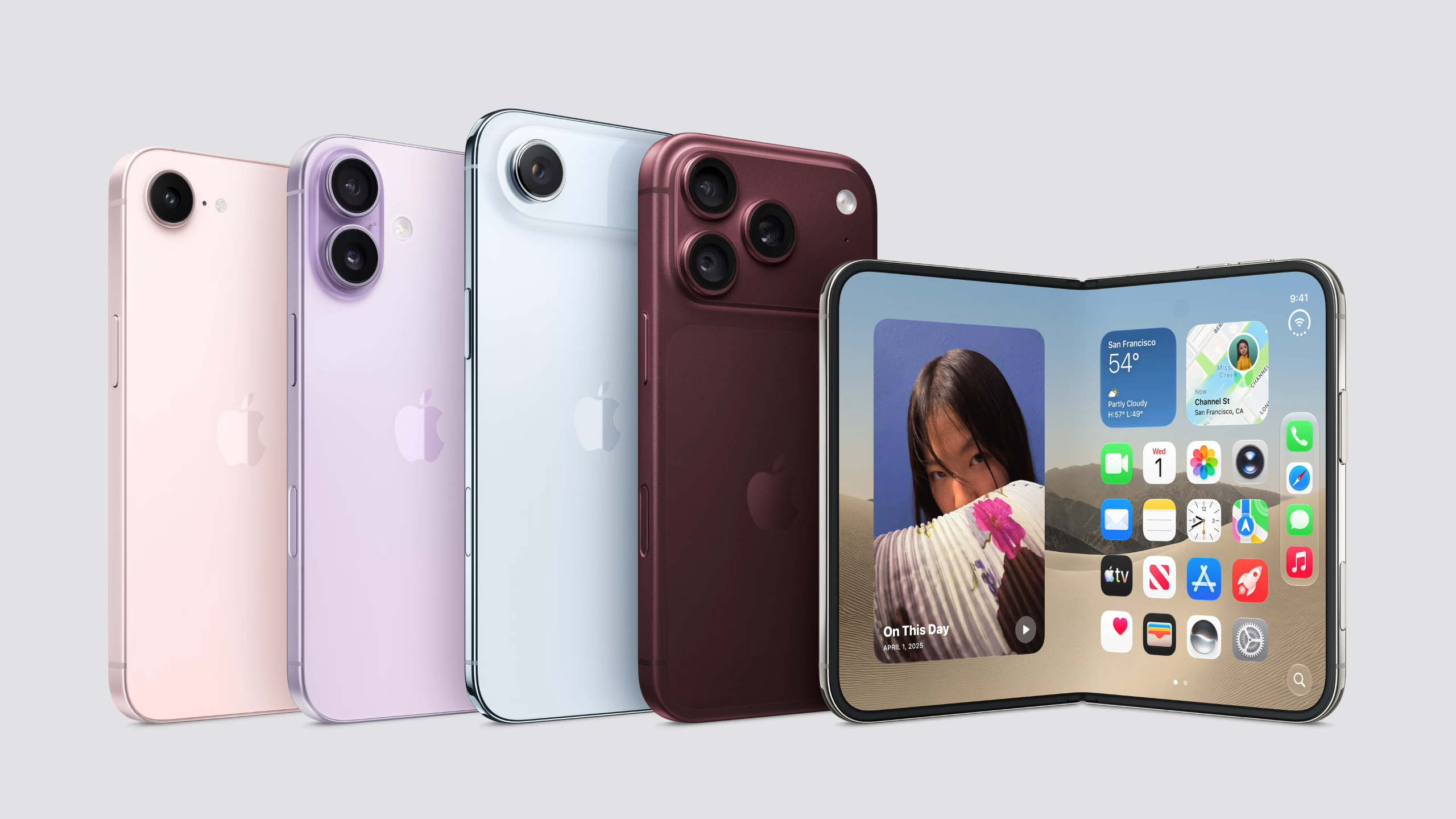
Apple finally folded, and the timing is the lesson
Yesterday Apple did the thing it had refused to do for the better part of a decade. It shipped a folding phone. The iPhone Duo arrived at a September event pointedly titled "Surprise and shine," and it was the first launch run by Apple's new chief executive, John Ternus, who took the seat on the first of the month after Tim Cook stepped up to executive chairman. Samsung has been selling foldables since 2019. Apple, as usual, was late. And also, as usual, the interesting story is not that it was late, but why, and what it decided to do with all that waiting. Here is how it looks from a builder's chair, across the three angles I care about most.
Product
The most revealing product decision was not the Duo at all. It was everything Apple chose not to release. There is no affordable iPhone this autumn. The whole launch is premium: the two 18 Pro models and the foldable, with the cheaper phones pushed into next spring. Apple has split its single most important product line in half and staggered it across two seasons, and that is a genuinely big shift for a company whose September event has been the metronome of the entire industry for over a decade.
Read it as a maturity signal. When a market stops growing quickly, the annual all-at-once refresh starts to work against you, because you are asking everyone to care about the same phone at the same time, whether it moved forward or not. So Apple is doing something more deliberate. It is putting its real innovation, the new form factor, at the front of the calendar for the holiday season, and holding the volume models back for their own moment.
The 18 Pro phones, by contrast, are honest iterations. A faster chip, a cleverer camera, a slimmer Dynamic Island that now juggles up to three live activities. Nobody is pretending those are revolutionary, and that is the point. Apple has learned to be relaxed about the fact that most of its phones each year are refinements, and to reserve the word "new" for the one place it genuinely applies.
The lesson underneath is one every builder with more than one product eventually has to learn. You do not have to make everything new every cycle. You decide where the real bet goes, you put your energy and your narrative there, and you let the rest iterate quietly. Spreading innovation evenly across a whole line is how you end up with a line that feels uniformly tired.
Design
Being last has one enormous advantage. You get to watch everyone else's mistakes for seven years before you make your own move. The Duo is Apple doing exactly that. The two things that have made foldables feel like a compromise, the crease down the middle of the screen and the sense that you are holding two phones glued together, are precisely the two things Apple spent its design effort attacking. The inner display is close to crease-free; it carries the same matte, low-glare finish Apple already uses on its high-end Macs and iPads, and the whole thing is engineered to read as one device that opens rather than two devices that unfold. Ternus framed rival foldables as feeling stuck together, and whatever you make of the jab, it tells you exactly where Apple decided the battle was.
You can see the same instinct in the smaller choices. The new Pro camera uses a variable aperture with physical blades, real optics, and moving parts, at a time when most of the industry is solving photography almost entirely in software. The Duo borrows a vapor-chamber cooling design lifted straight from the architecture of Apple's Mac processors. The color palette, the finishes, the materials all increasingly rhyme across the Mac, the iPad, and the iPhone. This is the part competitors cannot simply copy by matching a spec sheet, because it comes from designing the hardware and the software as a single object rather than negotiating between two teams. Integration is the moat. It has always been the case for Apple, and the foldable is the clearest recent proof, because a folding phone is the one product where any seam between hardware and software shows up instantly in your hand.
Market
Now the number everyone fixates on. The Duo starts at $1,999 and climbs toward $3,000 at the top. That is phone-as-laptop, and it sits well above the $1,299 Pro Max. It is easy to call that a problem, and for raw volume it may well be. But look at what the price does to everything around it. Against a nearly two-thousand-pound foldable, a $1,299 Pro Max suddenly reads as the sensible, grounded choice, which is exactly the trick a well-placed premium anchor is supposed to perform. Apple did not just launch a foldable. It raised the ceiling of its own range and, in doing so, quietly made the rest of the lineup feel more reasonable.
There is a real bet buried in here, and it is worth naming plainly. Apple is choosing a richer mix over a bigger unit count, at least for this season, and it is pricing the Duo close to Samsung's most expensive foldable rather than trying to undercut the category. Reports suggest Apple even gave up some of its usual margin to keep the launch price under two thousand, which suggests it wants the category to take hold, not just to skim off the earliest adopters. That is how you seed a new product line. You accept thinner economics at the start to buy adoption and learning, and you make fat margins later, once the category is normalized and manufacturing has matured.
And sitting above it all is the leadership story, which is really a strategy story in disguise. The first genuinely new iPhone shape since 2017 arrives in the same fortnight that a hardware engineer takes over from the operator who ran the company for fifteen years. You do not have to overread it to notice the signal Apple is comfortable sending. This is a company saying its next era will be defined by what it can build, not only by how efficiently it can ship.
What a builder takes from it
Strip away the logos and the price tags, and there are four moves here that apply to almost anyone building anything.
Being late is a strategy, not a failure, as long as you enter with a clear answer to the question of why the category has not worked yet. Apple did not launch a foldable until it believed it had solved the crease and the seam. Waiting bought it the right to arrive with a point of view instead of an apology.
Put your innovation where it counts and let the rest iterate. You cannot make everything new at once, and trying to is how you exhaust a team and confuse a customer.
Price is a story you tell, not just a number you pick. Anchors, ladders, and a willingness to sacrifice early margin to seed a category are all levers, and the item you never expected to sell in volume can still do enormous work by making everything beside it look reasonable.
And integration is the one advantage nobody can screenshot. The deeper your pieces are designed to fit together, the harder your product is to copy, because a competitor can match any single feature far more easily than they can match the way all of yours cohere.
Apple folded a phone in half yesterday. The more useful thing it folded was seven years of patience into a single, very deliberate bet, and that part you can borrow no matter what you are building.